Day 2: Norman and Mary Millar Lecture: Renewal begins when the Church learns to see again
25 October 2026
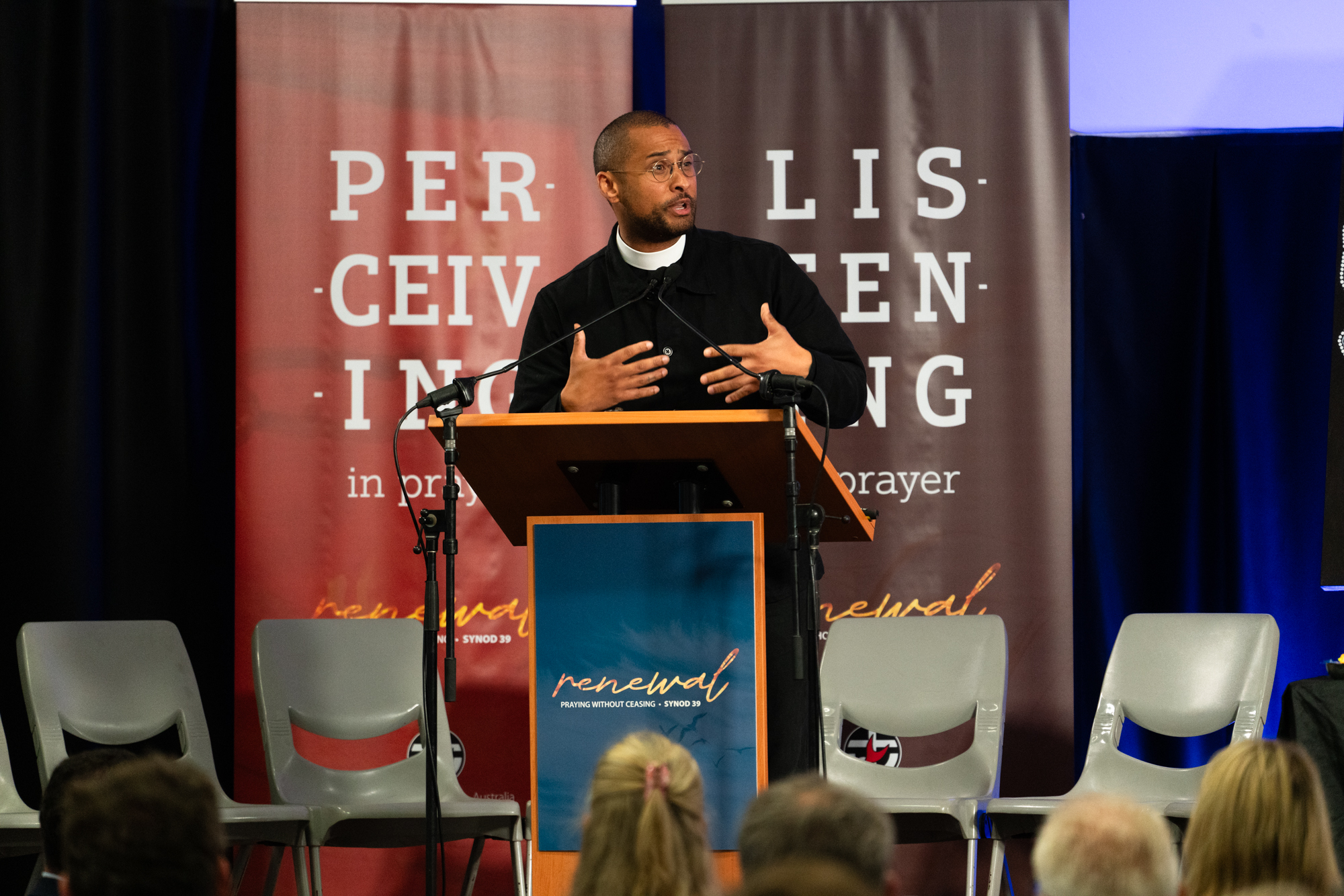
At the 39th Synod in Session, the 2026 Norman and Mary Millar Lecture invited the Church to consider how prayer, curiosity and courage might open new possibilities for mission and renewal.
What if renewal begins not with doing more, but with learning to see what God is already doing?
That was the question at the heart of the 2026 Norman and Mary Millar Lecture, where the Rev. Thomas Thomas invited members of the 39th Synod in Session to reconsider how the Church understands mission, responds to its communities and prepares for renewal.
Introduced by Moderator the Rev. Bruce Moore, Rev. Thomas brought experience from church revitalisation across London and Australia, drawing on his work with diverse Anglican traditions, his background in the creative industries and his own experience of encountering faith.
The lecture honours the life, faith and contribution of Norman and Mary Millar, whose commitment to the Church’s mission continues to inspire new generations of leaders. This year, the conversation connected closely with the Synod theme, Renewal: Praying Without Ceasing, exploring what it means to become more attentive to God, our neighbours and the work of the Holy Spirit.
For Rev. Thomas, renewal begins with a willingness to look again at the people and places the Church has been called to serve.
The quiet significance of the Church
Rev. Thomas opened with the story of a Benedictine monastery that relocated from its longstanding home in England during the 1950s. As the monks prepared to leave, people began arriving at the monastery, some upset and others in tears. The monks were surprised because many of these people had never met them.
Yet a common message emerged: “When you ring the bells, we know you’re praying.”
For Rev. Thomas, the story revealed something important about the Church’s presence in a community. Its significance may extend well beyond the people who attend Sunday worship. Churches can offer places of quiet, beauty and prayer where people find space to reflect, grieve or ask questions about life and faith.
He recalled his own experience as a student, when the pressures of study and life led him to seek refuge in a quiet English church. Although he had grown up in the Church of England without faith, sitting in the sanctuary and playing the piano gave him space to wonder whether there was more to life.
These experiences, he suggested, are part of the inheritance entrusted to the Church.
In a world marked by anxiety and uncertainty, the Church’s calling is not simply to preserve religious institutions, but to keep proclaiming the gospel and making space for people to encounter God.
Rev. Thomas posed a challenging question for congregations facing decline: if a church disappeared from its community, would anyone notice?
The question was not intended as a measure of attendance, but as an invitation to consider the difference a church makes in the lives of the people around it.
When renewal arrives unexpectedly
Rev. Thomas drew on his experience in East London, where he witnessed a remarkable period of growth in a congregation that had previously been small.
In 2020, the church had 19 members. By 2023, it had grown to nearly 400 people, most under the age of 40. Many were not Christians looking for a new church. They were people with little or no faith, arriving with difficult life experiences and searching for something they had not found elsewhere.
People came from backgrounds involving addiction, spiritual searching and personal struggles. The church found itself encountering people whose lives required more than a welcoming service or an appealing programme. They needed community, care and support as they explored faith.
The experience was both joyful and confronting. It revealed how unprepared the congregation had been to respond to the complexity of people's lives and how easily churches can become focused on maintaining their existing structures.
Rev. Thomas described the growth not as the result of a carefully engineered strategy, but as an unexpected gift of grace.
“It wasn't something we engineered,” he said. “It was a grace of God given to us for a moment, and it completely changed our journey.”
The experience also prompted a wider movement towards collaboration, as churches from different denominations and theological traditions began working together for the sake of the gospel.
For Rev. Thomas, renewal is not something the Church can manufacture or claim as its own achievement. It requires a willingness to recognise the work of God, even when it arrives in ways that challenge established expectations.
Paying attention to the life already present
Rev. Thomas identified three qualities the Church needs to rediscover: curiosity, courage and compassion.
He began with curiosity, drawing on his earlier career as a photographer and creative director. Working with film photography had taught him to slow down, pay attention to light and discover what was already present rather than trying to construct the perfect image.
He sees a similar discipline at work in mission.
Rather than beginning with a programme or a plan for growth, churches need to ask what is already happening in their communities. What gifts and hopes are present? What might God be doing among people the Church has overlooked? What kind of life is seeking to emerge in a particular place?
Rev. Thomas described this as a contemplative approach to mission, one that begins with listening and a willingness to be surprised.
“Curiosity allows us to discover things which we would have never produced in our own imagination,” he said.
This approach does not mean abandoning the Church’s traditions. Instead, it asks how the gifts of those traditions might speak afresh to the needs and longings of people today.
Rev. Thomas illustrated this through the story of a traditional Anglo-Catholic church in East London. Rather than reinventing its worship to imitate contemporary church trends, the congregation asked a simpler question: what might happen if it opened its doors and invited people in?
The resulting initiative, called Night Life, invited passers-by to enter the church, light a candle and write a prayer. Priests stood outside in their cassocks, holding lanterns and candles, while musicians and young people from other churches joined them.
Within two hours, 180 people had entered the church.
Some came to light candles and write prayers. Others were moved to tears and asked for prayer.
The church had not abandoned its identity or its liturgical tradition. It had simply found a new way to offer its gifts to the surrounding community.
The story illustrated Toby’s central point: sometimes the next step in mission is not to invent something new, but to recognise the value of what is already there and make it accessible to others.
“The question simply isn't what has worked before, or what did they do. The question is, what is the life that wants to live in this place?”
Courage to act on what we see
Curiosity, Rev. Thomas argued, must eventually lead to action. Recognising possibilities is only the beginning; the Church also needs the courage to respond.
He shared the story of a woman from a parish in East London who continued to serve others after moving into residential care. When Rev. Thomas visited her, she explained that being confined to her bed had not ended her sense of mission.
The carers who visited her were often not Christians, and she would talk with them about Jesus. On one occasion, a carer shared that he wanted to learn how to pray because he felt an emptiness in his life. Having recently read the biblical story of the woman at the well, she told him, “I can give you living water.”
They read the story together and prayed. The man subsequently became a Christian.
Even after moving into care, she continued to look for opportunities to pray for others. She told Rev. Thomas that she now went out on her mobility scooter once a week to a busy road, where she would sit and pray that God would bring someone to her.
Her story challenged conventional ideas about where ministry happens and who is equipped to lead it.
Rev. Thomas also reflected on two experienced lay ministers who had served their local community faithfully but had been discouraged from pursuing ordination because the requirements would have meant leaving the place where they were already making a difference.
For Rev. Thomas, these examples reveal what can happen when the Church fails to recognise the gifts of its people or imagine different ways for them to serve.
Renewal requires leaders who can identify and encourage those gifts, rather than allowing institutional expectations to limit them.
Renewal begins with honesty and reconciliation
Toby's final challenge turned towards the Church itself.
He argued that renewal requires leaders to be honest about the ways their own attitudes and practices may have become obstacles to mission. He shared the story of a church leader who recognised that he had stopped being curious and courageous, losing his expectation that God might do something new.
That recognition became a starting point for spiritual renewal.
“We cannot cure that which we do not diagnose,” Rev. Thomas said, calling leaders to begin by examining their own hearts and acknowledging where they may have lost their openness to the Holy Spirit.
He also stressed that renewal cannot be separated from the relationships within the Church. Drawing on his experience in an ecumenical monastic community, he described practices of reconciliation that required people to address conflict directly and seek peace with those who had hurt them.
Unity does not mean avoiding difficult conversations or pretending disagreements do not exist. It means being willing to work through them so that the Church can remain a credible witness to the gospel.
As the Synod gathered to discern its future, Toby's message was both a challenge and an invitation: to become more attentive to the people and communities around us, to act with courage when new possibilities emerge, and to pursue renewal in our own lives and relationships.
The task is not to reproduce someone else's experience of revival or to assume that a particular strategy will work everywhere. It is to listen carefully to the place in which God has called each congregation, and to remain open to what might emerge.
Renewal may begin with a new initiative or a different way of working. It may also begin with something quieter: a church bell ringing, a door being opened, a prayer being offered, or a leader learning to see the gifts that have been present all along.
As Rev. Thomas reminded the Synod, the Church's calling is not simply to manage what it has inherited, but to remain attentive to the life God is bringing into being.
That begins with learning to see again.


Discipleship
Discipleship & Mission
Children, Youth, Young Adults and Families
Journey
Latest stories
Browse the latest stories of the Church