Day 3: ‘This is who we are’: Moderator calls Synod to recognise the Church’s ministry in the world
26 October 2026
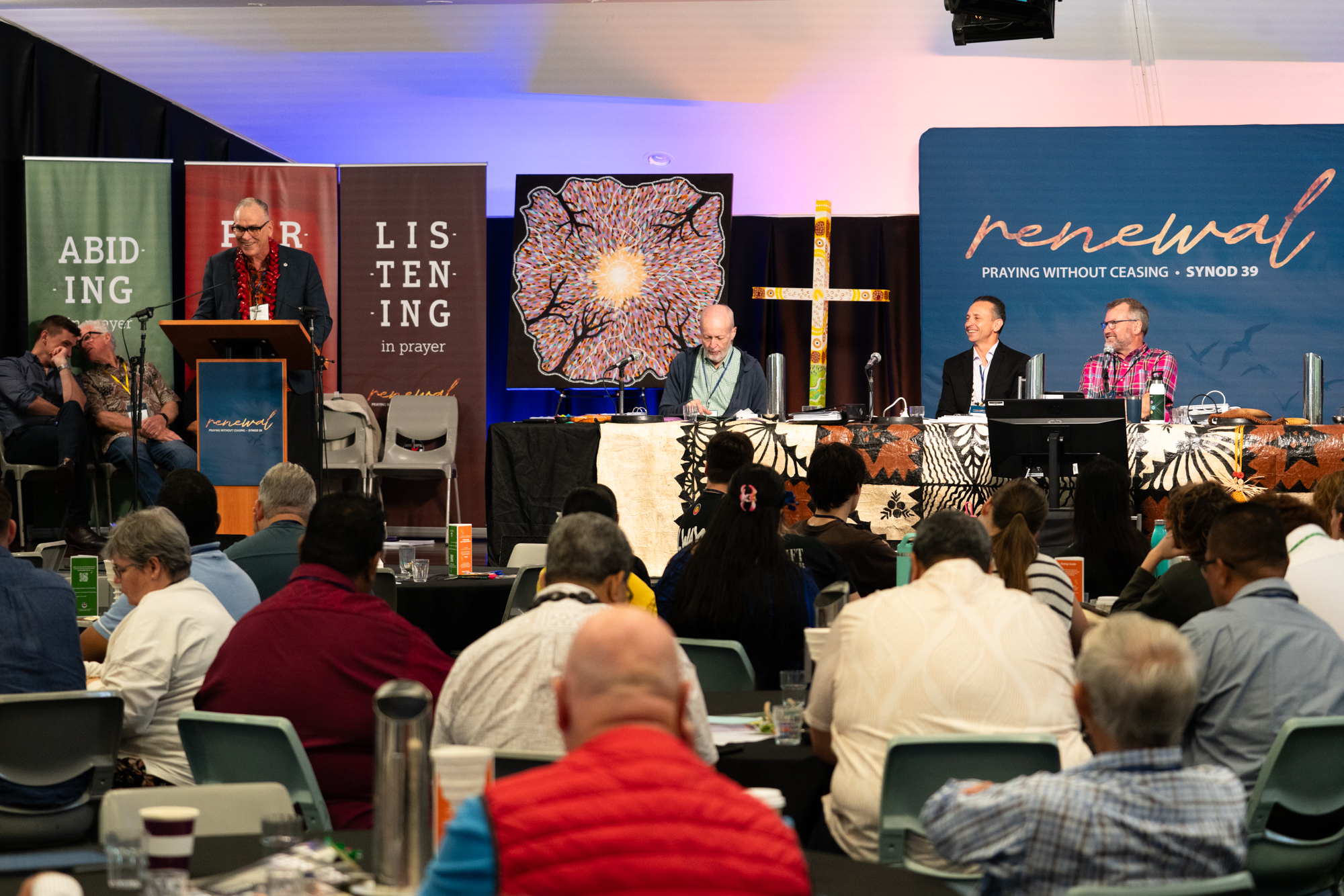
‘This is who we are’: Moderator calls Synod to recognise the Church’s ministry in the world
The Moderator, Rev. Bruce Moore has invited members of the 39th Synod to recognise the breadth of the Uniting Church’s ministry, sharing stories of communities responding to addiction, accompanying families through the loss of a child, standing alongside Pacific neighbours facing climate change and investing in the formation of young people.
In his address accompanying the Moderator’s Report to Synod 39, the Moderator reflected on the privilege of visiting congregations, schools, hospitals, agencies and remote communities, witnessing both the extraordinary beauty of the Church’s work and the deep disappointments experienced by the people it serves.
“It’s an absolute privilege to represent you, to have the opportunity to listen, deeply listen, and even more so, the opportunity to actually pray,” he said.
Through five stories drawn from his ministry, Rev. Moore offered Synod members a window into the work of the wider Church, including ministries that may not always receive attention but are central to its identity and calling.
“This is part of who we are,” he said. “This is part of the work that we do.”
Seeing the person beyond their circumstances
Rev. Moore began in Far North Queensland, sharing the work of the Cape York Family Centre, operated by Pinangba Services within UnitingCare’s Blue Care services. The ministry is led by and focused on First Nations people, supporting people experiencing addiction through a culturally informed approach that recognises the importance of family and community.
Rather than treating addiction simply as an individual problem to be fixed, the centre brings families and community networks into the process of healing. Families or community groups can live in residence, with support tailored to their circumstances. The ministry also continues to support people as they return to their communities.
The approach challenges the labels that can define people by their most difficult experiences.
“We live in a society where people find themselves living out the label that we give to them,” Rev. Moore said.
He observed that people struggling with addiction can become defined by the worst part of their story, rather than being seen in the fullness of their lives and relationships.
The centre offers another possibility: a new future shaped by healing, wholeness and restored relationships.
“Maybe some of us here this morning are struggling and defined by the worst thing that ever happened in your life,” he said. “And the ministry that we’re part of, as the Cape York Family Centre, actually gives people an opportunity to write a new future of healing, of wholeness, of relationship.”
For Rev. Moore, this ministry represents an important expression of the Church’s identity, demonstrating how care that honours culture, family and community can create opportunities for renewal.
Accompanying families through the hardest moments
Rev. Moore’s second story took Synod to Hummingbird House, which supports children with life-limiting conditions and their families through palliative care.
Reflecting on the ministry’s tenth anniversary, he spoke about the importance of accompanying families facing circumstances no parent would choose and for which there are often no adequate words.
“There are some places where our words simply just don’t work,” he said.
In these moments, the Church cannot offer easy explanations or neat answers. Instead, it can create spaces where families are held in their grief, their stories are honoured and precious memories can be made.
At Hummingbird House, children are not reduced to their diagnoses, and families are not treated simply as clients.
“A family is not simply a client. People are actually known, stories are honoured, and memories are actually created in this environment,” the Moderator said.
He described this as a ministry that reflects the way of Jesus: remaining present with people in the midst of pain, rather than attempting to explain it away.
The story offered Synod a reminder that the Church’s ministry is not always about finding solutions. Sometimes it is about making room for love, dignity and connection when life cannot be made easier.
Pacific relationships demand more than solidarity
Rev. Moore also reflected on a visit to Tuvalu with the Uniting Church’s President and a Synod delegation to attend the 29th General Assembly of the Ekklesia Kila Sonio, the Tuvaluan Congregational Christian Church.
During the visit, the churches renewed their memorandum of understanding and, more importantly, strengthened a relationship grounded in worship, discipleship and mutual solidarity.
The visit brought the reality of climate change into sharp focus.
“When you stand on the shores of Tuvalu, climate change is not an abstract theological or political debate,” Rev. Moore said. “It is a lived reality.”
For Tuvaluan communities, the threat of rising seas extends far beyond the loss of land. Their land carries family histories, culture, memories, identity and faith.
Yet amid these challenges, the Moderator witnessed extraordinary hospitality, generosity, prayer and joy.
He connected this experience with the New Testament concept of koinoneia, a word associated with fellowship and community. For him, this is more than a description of relationships between churches. It carries a responsibility to act when the wellbeing of others is threatened.
“If we step into relationship, we don’t have a choice here,” he said. “That’s what God requires us: to do what is just, to show constant love, and walk humbly with our God.”
Rev. Moore then recalled the message shared by Pacific church leaders in the context of preparations for COP31:
“We are sinking. We are vulnerable. Resilience is no longer enough.”
He challenged Synod members to hear these words as a call to move beyond admiration for the resilience of Pacific communities and towards meaningful action.
“Please don’t simply admire us for our resilience. Listen to us,” he quoted the leaders as saying.
He also shared a more confronting appeal:
“Do not stand at the foot of our suffering and admire us for how bravely we carry the cross of climate change. Help us take the cross down.”
For Rev. Moore, these words speak directly to the Church’s responsibility to its Pacific neighbours. Relationship requires more than sympathy. It calls for listening, advocacy and action alongside those most affected.
He also acknowledged the work of the President in connecting care for creation with justice for First Peoples and listening to Pacific neighbours through the Season of Creation theme, Living Water, drawn from Ezekiel 47.
The Church’s presence in the formation of young people
Closer to home, Rev. Moore shared his experience of attending the consecration and commissioning of Emma Graves as the new principal of Scotts PGC College in Warwick.
The school has faced challenges, particularly those affecting communities in central and western Queensland from which many of its students come. Yet the Moderator described the Church’s presence in its schools as a significant opportunity to support young people during their formative years.
He acknowledged that some may question why the Uniting Church continues to invest in schools, but argued that these institutions provide an important place for the Church to contribute to education, formation and community life.
“God gives us this great gift of presence in that place,” he said.
The commissioning service brought together more than 500 people from the school, the wider community and the Church. For Rev. Moore, the gathering was a sacred opportunity to pray for the new principal and the community she would lead.
His reflection reinforced a wider theme of the address: the Church’s ministry is expressed not only through congregations and formal worship, but also through its presence in the institutions and relationships that shape people's lives.
Recognising the ministry of every community
Rev. Moore’s final story was not about one organisation or event. It was about the hundreds of stories unfolding in congregations and communities every day.
He acknowledged the people who open their lives to others, offering care, witness and the love of Christ in their own places and circumstances.
“Today, I want to acknowledge you,” he said.
“I want to acknowledge you as being God’s agent, God’s commissioned people to be the ministry of Christ in the midst of that.”
The recognition was both an affirmation of the Church’s existing ministry and a reminder of the responsibility carried by its members.
Rev. Moore connected this calling with his own family, sharing a photograph of his four grandsons that he keeps before him as he undertakes his daily work. Alongside it, he keeps a photograph of a young girl whose family had experienced childhood sexual abuse within the Church.
The two images hold together the promise of the Church’s future and the responsibility to acknowledge and respond to the harm it has caused.
Rev. Moore described a direct response conversation in which he and the General Secretary listened to a family affected by this abuse. The family’s request that the photograph remain before them was a reminder of the importance of keeping those harmed by the Church in view.
His reflection made clear that the Church’s responsibility to nurture young people cannot be separated from its responsibility to confront its failures and create environments where children can grow in safety and develop a full understanding of who they are.
The work, he said, is not simply about the future of the Church as an institution. It is about enabling young people to encounter a community that expresses the transformative love of God in Jesus.
“This is who we are. This is what we’re part of,” he said.
A Church shaped by prayer and responsibility
Across the stories, Rev. Moore returned to a consistent message: the Church is called to recognise people in the fullness of their humanity, remain present in suffering, pursue justice and take responsibility for the relationships in which it participates.
His address invited Synod members to look beyond familiar measures of church life and recognise the often-unseen work taking place across the Uniting Church’s diverse communities and ministries.
It also challenged the Church to consider what its relationships require of it, particularly when those relationships bring it face to face with injustice, grief, vulnerability or its own failures.
Rev. Moore concluded by turning to prayer, acknowledging that the work ahead cannot depend on human strength alone.
“Come, Holy Spirit. Come,” he said. “It may not rely on our strength, but it may rely on your strength, God.”
His address left Synod with a reminder that the Church’s calling is lived out in practical acts of accompaniment, care, justice and accountability, wherever people need to encounter the love of God.

Discipleship
Discipleship & Mission
Children, Youth, Young Adults and Families
Journey
Latest stories
Browse the latest stories of the Church