Day 3: Renewal calls the Uniting Church to deeper relationships, justice and shared responsibility
26 October 2026
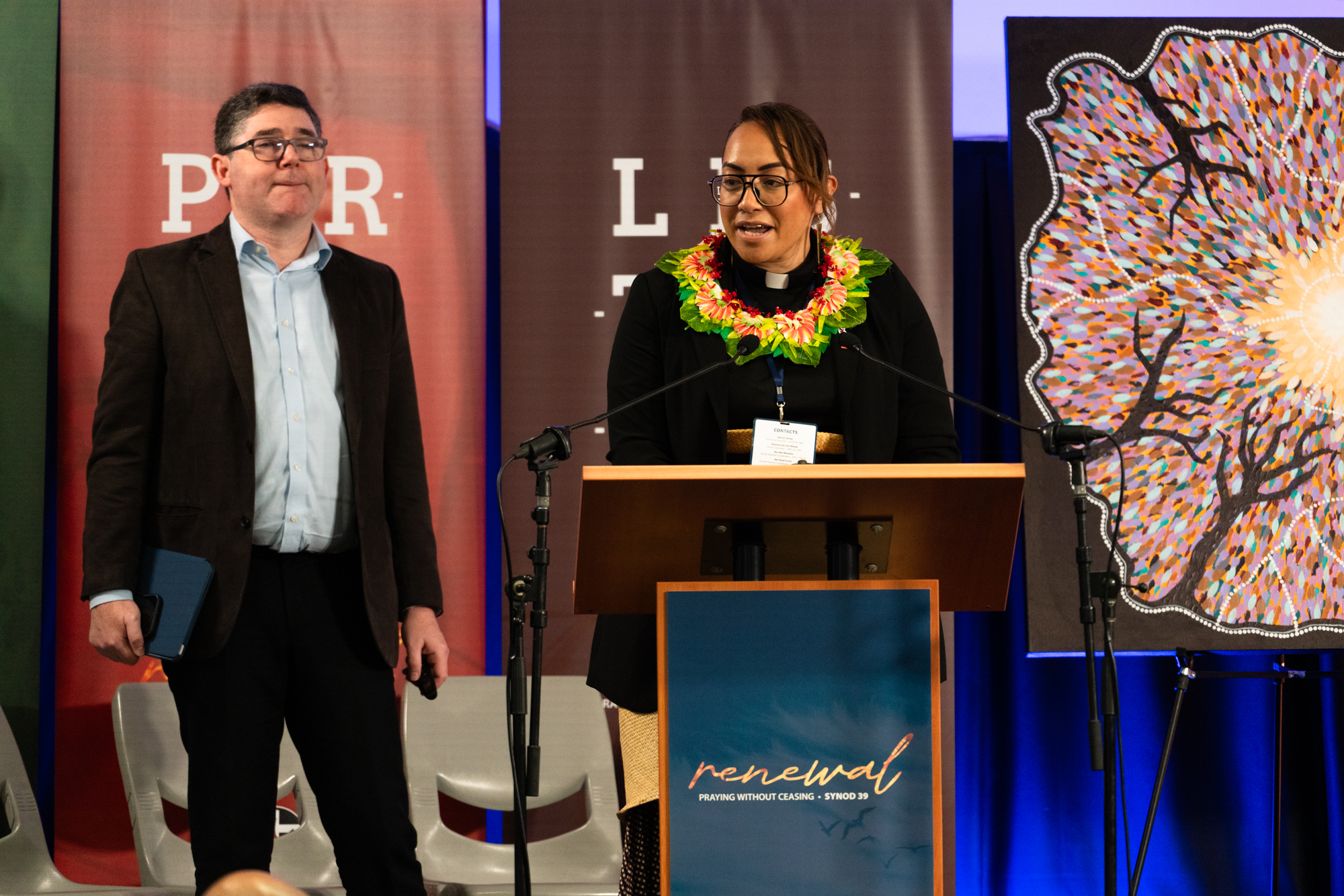
President Rev. Charissa Rev. Suli and National General Secretary Andrew Johnson have challenged the Uniting Church to embrace renewal through stronger relationships, accountable leadership and a renewed commitment to justice as the Church prepares to mark its 50th anniversary.
Addressing the 39th Queensland Synod as part of the National Assembly report, Rev. Charissa Rev. Suli and Andrew Johnson outlined the opportunities and challenges facing the national Church, from climate justice and First Peoples’ leadership to younger generations, governance reform and the future sharing of resources.
Their messages carried a common theme: the Church must be willing to change how it works together if it is to remain faithful to its calling.
Renewal begins with relationships
President Rev. Charissa Rev. Suli acknowledged the difficult conversations taking place across the Queensland Synod about presbytery capacity, leadership, governance and sustaining communities for mission.
She recognised that these questions are not simply administrative. They touch communities people love, relationships built over many years and ministries that remain deeply important to congregations.
“You are not alone in facing these questions,” she told Synod members, noting that similar challenges are being wrestled with across the national Church.
She pointed to paragraph four of the Basis of Union, which affirms that Christ rules and renews the Church, reminding members that Christ continues to call the Church into faith and discipleship through changing historical circumstances.
For Rev. Suli, this understanding of renewal requires more than preserving existing structures. It calls the Church to examine the relationships and systems that shape its common life.
Reflecting on the theme of the National Assembly’s triennium, she described the Church as a community in which different threads are woven together. But she cautioned that weaving also requires the courage to identify what needs repairing and what must be unpicked.
“Sometimes what needs to be unpicked is not simply a strained relationship, but a way of exercising power, making decisions that will determine whose voices are heard,” she said.
Her words offered a challenge to Church leaders to consider whose perspectives shape decisions, how power is exercised and whether the Church’s structures enable all its members to participate meaningfully.
Rev. Suli also emphasised that the different councils of the Church cannot operate in isolation.
“We have different responsibilities across our councils, but we belong to one another in Christ,” she said.
The decisions made by one part of the Church have consequences for others. As the Church discerns its future, she urged members to consider not only what benefits their own council or community, but what strengthens the shared life and witness of the Uniting Church in Australia.
Justice must shape the Church’s life
Rev. Suli highlighted the National Assembly’s public advocacy on dignity, safety and the wellbeing of people, including calls for peace in the Middle East, the protection of civilians, justice for First Peoples and action to confront racism within the Church.
She also reaffirmed the importance of climate justice, particularly in solidarity with Pacific neighbours and the wider global Church.
Drawing on her recent visits to Tuvalu and a Pacific pre-COP gathering in Fiji, Rev. Suli connected the climate crisis with the relationships between people, Country, culture and generations.
Before travelling to the Pacific, she had asked members of the National Congress what they wanted her to carry into those conversations. Congress leader Uncle Ken offered a response that stayed with her:
“Climate change from where I sit is fundamentally about relationship.”
Rev. Suli shared the story of a young girl on Skye Island in the Torres Strait who has been collecting bottles and cans and using the refund money to buy sandbags to protect the cemetery where her ancestors are buried from rising seas.
“A young child trying to protect the resting place of her ancestors,” Rev. Suli said. “A child should not have to carry a responsibility that belongs to all of us.”
The story brought the consequences of climate change into sharp focus. For First Peoples and Pacific communities, the threat is not simply environmental. It affects Country, family, culture, identity and the connections between generations.
Rev. Suli also thanked Queensland Synod leaders and those working locally to support Tuvaluan families who have had to find a new home in Australia.
Her message reinforced the need for climate advocacy to be grounded in relationships and responsibility, including action alongside communities experiencing the consequences of a changing climate.
Looking towards the next 50 years
With the Uniting Church preparing to mark its 50th anniversary in 2027, Rev. Suli encouraged Synod members to treat the milestone as an opportunity for honest reflection rather than celebration alone.
She invited the Church to consider three questions: what it should give thanks for, what it needs to lament, and what Christ is calling it to change as it enters its next 50 years.
“My hope is that as we enter our next 50 years, that we will not be a church that continues to turn inwardly, but we will be a people whose life together makes the love, justice, and hospitality of Jesus Christ visible in the world,” she said.
She encouraged congregations and faith communities to tell the stories of faith and service already taking place across the country, helping Australians see the difference the Gospel makes in people’s lives.
The anniversary will also provide an opportunity to strengthen the Church’s commitment to First Peoples and the covenant with the Uniting Aboriginal and Islander Christian Congress (UAICC).
Rev. Suli invited Queensland Synod to support Health Together, a gathering of young adults from across the Uniting Church planned for January 2027 at the Maru Christian Centre in New South Wales.
She urged the Synod to invest in its young people and make it possible for them to attend, presenting the gathering as a practical response to concerns about younger generations, discipleship and leadership.
Health Together is being co-hosted and co-led with Congress, with First Peoples involved in developing and implementing the gathering rather than being invited only after the programme has been determined.
The vision is to begin the anniversary year in worship, on Country and in covenant, drawing on stories, relationships with Country and spiritual wisdom to nurture young people’s faith.
Rev. Suli also noted that National Congress had committed to bringing 100 First Nations young people, accompanied by their Elders, to the gathering.
She invited older members to consider volunteering and accompanying younger participants.
As the Church approaches its next chapter, she said, it must make space for a new generation to help shape the Church it is becoming.
A national Church with a shared mission
National General Secretary Andrew Johnson expanded on the national priorities, outlining the work of the Assembly, its agencies and the reform programme known as Act 2.
He began by looking ahead to 8 July 2027, when the 18th Assembly will gather in Adelaide to mark the Uniting Church’s 50th anniversary.
The anniversary will bring together Uniting in Prayer, a 50-day period of prayer across the Church, and Uniting in Action, a corresponding 50-day period focused on action.
Johnson encouraged Queensland Synod members to participate in both initiatives as the Church prepares to celebrate its history and consider its future.
He also highlighted the need to develop new generations of leadership. The age limit for younger Assembly members has been increased from 25 to 30, which he described as a small but telling indication of the work still required to create opportunities for younger leaders.
While acknowledging the challenges facing the Church, Johnson urged members not to overlook the people and gifts available to support its mission.
“At a time when it can be easy for us to focus on what we are losing, we should not overlook the gifts God continues to provide,” he said.
He outlined the continuing work of the Assembly’s three national agencies: Frontier Services, United Care Australia and United World.
Frontier Services continues its work in rural and remote Australia through Bush Chaplaincy and Outpost Links. United Care Australia is strengthening collaboration across its network of community service agencies and national advocacy. United World accompanies partner churches across Asia, the Pacific and Africa.
Johnson argued that these ministries demonstrate the value of the Church working collectively.
“Our shared life enables us to undertake ministries that none of us could undertake alone,” he said.
The agencies are a reminder that the Uniting Church is more than a collection of local congregations. Its national relationships enable ministries, partnerships and advocacy that would be difficult for individual communities to undertake independently.
Three priorities for the national Church
Johnson outlined three goals guiding the National Assembly’s strategy: flourishing faith, thriving communities and liberating justice.
Flourishing faith focuses on extending the table to everyone and inviting people to follow Jesus with courageous faith.
A central part of this work is renewing the covenant with Congress, including establishing sustainable economic foundations for Congress, a commitment dating from 1994 that Johnson acknowledged had never been fully realised.
The Assembly is also reviewing liturgical standards to better reflect the Church’s covenant commitments, intercultural identity and theological and worship diversity.
Thriving communities focuses on strengthening the national Church so local communities can flourish. Priorities include engaging younger leaders in the global Church, developing a national framework for the ministry of pastor and reviewing the implementation of the Church’s discipline regulations.
Johnson emphasised that governance and administrative processes should serve the Church’s ministry rather than become ends in themselves.
“Good governance is not an end in itself. It should be enabling the church to exercise its ministry faithfully and effectively,” he said.
Liberating justice focuses on using the Church’s voice and actions to confront injustice in Australia and internationally.
This includes working with Synods towards net zero carbon emissions by 2040, advocating for climate justice alongside Pacific churches and strengthening national advocacy in an increasingly polarised political environment.
Johnson also confirmed the Assembly’s commitment to developing an action plan for becoming an anti-racist Church.
“Our commitment to justice must not just shape what we say, but how we order our life and act together,” he said.
The statement brought the Assembly’s public advocacy into direct relationship with its internal life. The Church’s commitment to justice must be reflected in its leadership, structures, decisions and relationships, not simply in public statements.
Act 2 and the future shape of the Church
Johnson also outlined the work underway through Act 2, which seeks to align the Church’s structures with its continuing calling to discipleship and mission.
He described the programme as holding together confidence in God’s continuing call to the Uniting Church and an honest recognition that existing arrangements are no longer adequately serving that call.
The work is organised around three streams.
The first focuses on life-giving communities of discipleship and mission, including proposed constitutional amendments to provide greater flexibility in governance arrangements. The Assembly is also developing proposals concerning Church membership, with a focus on moving from confirmed membership towards active membership grounded in baptism as the foundation of Christian belonging.
The second stream focuses on theological education and a flourishing theological culture. This includes research and discernment about a comparative education provider, greater collaboration across theological education and work on discipleship, mission and evangelism.
Johnson said theological learning and reflection needed to become part of the life of the whole people of God.
The third stream focuses on sharing the Church’s common life and wealth. Work includes considering the conciliar shape of the Church, more equitable distribution of resources across Synod boundaries and a shared administration proposal developed by the Queensland Synod General Secretary for consideration at the 18th Assembly.
These proposals raise significant questions about how authority is exercised, how resources are distributed and how the Church organises its common life.
For Queensland Synod, those questions connect directly with its own discussions about the future of presbyteries and how governance arrangements can better support congregations in their calling.
Johnson reminded members that presbyteries have a responsibility under the Basis of Union to exhort congregations to fulfil their high calling in Jesus Christ.
That responsibility, he said, must remain central as the Church considers its future structures.
A covenant that must be lived
In his closing remarks, Johnson returned to the covenant with Congress, the Church’s intercultural identity and the place of women and younger generations in its life.
He acknowledged the significance of Queensland Synod’s recognition of his father, the Rev. Duncan Harrison, at the service of ministries earlier in the gathering. He described his father’s ministry as extending across evangelism, union, spirituality and justice for First Peoples.
Johnson said he would continue to challenge the Synod on its covenant commitments, not from a position of separation, but because of his affection for the Church that had formed his faith.
“I will continue to note and challenge you about the covenant of Congress, intercultural identity, the leadership of women in the place of younger generations in the life of the church, not because I want to stand apart from the Synod, but because I love the Synod that formed my faith,” he said.
His words captured a central tension in both addresses: the Uniting Church has significant gifts, a rich history and a continuing sense of vocation, but it must be willing to examine where its practices fall short of its commitments.
As the Church approaches its 50th anniversary, Rev. Suli and Johnson invited members to look forward with hope while remaining honest about the work of renewal still required.
The challenge is not simply to preserve the institution for another 50 years. It is to build a Church whose relationships, leadership, use of resources and public witness make its commitments to Christ, First Peoples, justice and younger generations visible in practice.


Discipleship
Discipleship & Mission
Children, Youth, Young Adults and Families
Journey
Latest stories
Browse the latest stories of the Church