Day 2: Bible Study - Perceiving in prayer the call to renewal
25 October 2026
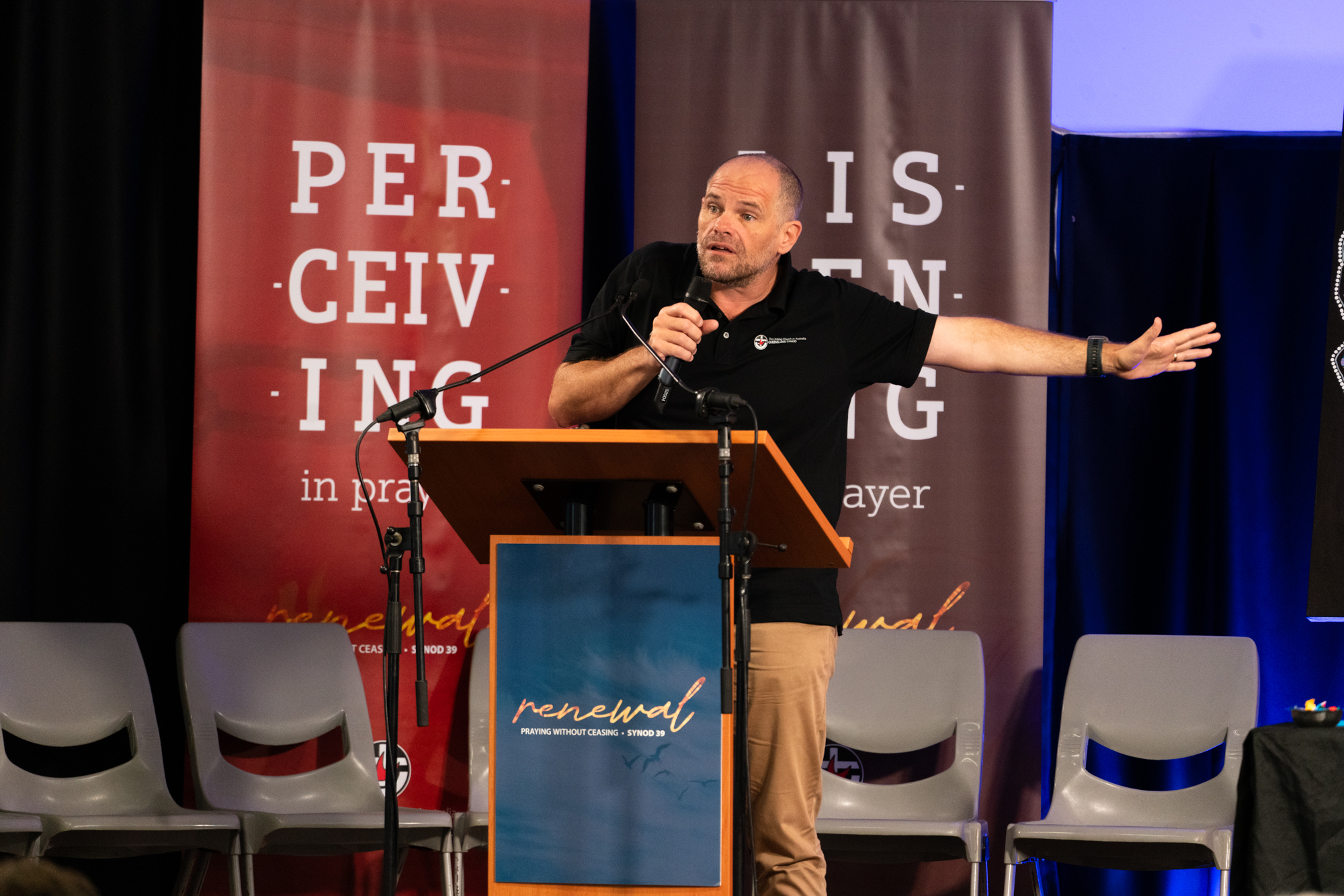
by Rev. Ralph Mayhew
Perceiving in prayer: Rev. Ralph Rev. Mayhew explores the call to renewal
In a Bible study on Colossians 3:1–17, Rev. Ralph Rev. Mayhew invited the 39th Queensland Uniting Church Synod in Session to consider how prayer reshapes the way the Church sees the world, understands its identity and participates in God's work of renewal.
What happens when the Church loses sight of what sits at its centre?
This was the question at the heart of Rev. Ralph Mayhew's Bible study on Saturday, as Synod members gathered under the theme Renewal – Perceiving in Prayer to explore Paul's letter to the Colossians.
Rev. Mayhew began with the story of Colossae, a town that had lost its former prominence. Its healing pools had dried up, its influence had waned, and it was no longer a centre of culture or commerce. Yet it was here that a local man, Epaphras, encountered the gospel, returned home and established a Christian community.
For several years, the church flourished. But as different religious beliefs and philosophies competed for people's attention, Epaphras became concerned that Christ was being displaced from the centre of the community's faith and life. He turned to Paul for guidance.
Rev. Mayhew drew a connection between the Colossian church's experience and the challenges facing Christians today. Just as the early church navigated competing worldviews, contemporary believers encounter many competing ideas about identity, meaning and what makes a good life.
The danger, he suggested, is not always an outright rejection of Christ. Sometimes it is a gradual shift, as other priorities and ways of thinking quietly take centre stage.
Paul's response in Colossians 3 offers a way forward: set your hearts and minds on things above, and allow the life of Christ to shape everything you do.
For Mayhew, this is fundamentally an invitation to prayer.
Prayer is not simply another task to add to an already busy life. It is a way of returning to Christ, relying on the Holy Spirit and learning to see our circumstances through God's purposes rather than being consumed by the immediate pressures around us.
Reflecting on his own demanding weeks in ministry, Rev. Mayhew spoke candidly about how easily his attention had become absorbed by problems, decisions and the things that might go wrong. Studying the passage challenged him to redirect his thinking towards Christ.
He returned to a line attributed to poet and artist William Blake: “We become what we behold.”
The idea offered a simple but challenging insight for the Church. What we continually give our attention to shapes our thinking, our priorities and ultimately our actions. Prayer creates space to turn our attention towards Christ again.
Putting on the character of Christ
Rev. Mayhew also explored Paul's instruction to put aside the practices of the old life and put on the new self found in Christ.
He emphasised that this is not primarily about trying harder to become a better person. Rather, it begins with recognising the new life already offered through Christ's death and resurrection.
The Christian life is not about returning to old ways of seeking security or trying to save ourselves. It is about learning to live from the new identity we have received in Christ.
Paul describes what this new life looks like through compassion, kindness, humility, gentleness and patience.
Rev. Mayhew challenged members to understand these qualities not simply as virtues to work harder at displaying, but as the fruit of lives shaped by prayer, communion with God and openness to the Holy Spirit.
In a world where power, status and aggression can be celebrated, a community formed by these qualities offers a different way of living. The Church's witness becomes visible not merely through what it says it believes, but through how its people treat one another and engage with the wider world.
This has implications for the Church's relationships, leadership, mission and decision-making. If Christ is at the centre, that identity should be evident in the way the Church conducts itself.
Everything in the name of Jesus
Rev. Mayhew brought the study back to Paul's instruction in Colossians 3:17: whatever Christians do, in word or deed, they are to do in the name of the Lord Jesus, giving thanks to God.
To act in someone's name, he explained, is to represent them. Christians are therefore called to carry the name of Jesus into the places they inhabit, the decisions they make and the relationships they sustain.
For the Church, this means seeing its work as participation in God's redemptive purposes for the world. Prayer is not an escape from the demands of ministry or mission. It is what helps the Church discern how to participate faithfully in God's work.
Rev. Mayhew cautioned against treating the passage as a checklist of behaviours to complete. Its deeper invitation is to reorient our lives around Christ: our thoughts, words, actions, worship, mission and values.
The same Spirit who renewed the Colossian church, he said, continues to invite the Church today into this renewal.
Making room for renewal
The study concluded with a moment of quiet reflection using a Coolamon, a traditional vessel woven by First Nations women and used to carry food, water and other items.
Rev. Mayhew invited members to consider what they needed to place in God's Coolamon and entrust to God, rather than continuing to carry it themselves. The vessel became a tangible focus for prayer, surrender and listening to the Spirit.
The invitation was personal, but its implications extended to the life of the whole Church.
As Synod continues its work of discernment, Colossians 3 offers a reminder that renewal begins not simply with new structures, plans or decisions, but with a renewed understanding of who the Church is in Christ.
To perceive in prayer is to look beyond immediate pressures, familiar assumptions and competing voices. It is to return our attention to Christ and allow that attention to reshape how we live, how we lead and how we serve.
The question Rev. Mayhew left with members was not simply what they needed to do differently, but what they were being called to entrust to God.
Perhaps that is where renewal begins: not with the determination to carry everything ourselves, but with the willingness to listen, surrender and let Christ take his rightful place at the centre.


Discipleship
Discipleship & Mission
Children, Youth, Young Adults and Families
Journey
Latest stories
Browse the latest stories of the Church