Reflection for Trinity Sunday
25 May 2026
by Kym Korbe, Koa Kuku Yalanji woman, Executive Officer UAICC & Covenanting
Inspired by the Gospel of Matthew 28:16-20 NRSVUE
The Commissioning of the Disciples
Now the eleven disciples went to Galilee, to the mountain to which Jesus had directed them. When they saw him, they worshiped him, but they doubted. And Jesus came and said to them, “All authority in heaven and on earth has been given to me. Go therefore and make disciples of all nations, baptizing them in the name of the Father and of the Son and of the Holy Spirit and teaching them to obey everything that I have commanded you. And remember, I am with you always, to the end of the age.”
Trinity Sunday asks us to remember humbly an ancient truth, that we are called into relationship with the one most high God, through our relationships with each other. In Aboriginal missiology, we begin not with abstract notions of who God is, but with creation, relationship, story, place, and belonging. Our Triune God is not distant from creation but present within it, around it, and sustaining it. Creator, Christ, and Spirit are known in the deep connectedness of life: in Country that holds memory, in community that shapes identity, and in Spirit that breathes through all that lives. The mystery of the Trinity reminds us that God’s life is endlessly relational, and that relationship itself is to be viewed as sacred.
From an Aboriginal missiological perspective, discipling peoples through mission is not conquest, control, or the erasure of culture. Instead, the Trinity reveals a different way: a life of mutuality, honour, and shared presence. The Father displays majesty through creation, and draws you nearer through the Son, the Son does not displace the work and movement of Spirit, and the Spirit does not draw attention away from the Father; each are love, together they are fulfilment. So too, faithful mission must be grounded in respect, listening, and acting for the flourishing of all peoples, as peoples called by God, bearing their own authority, wisdom, and witness.
Within this vision, disciple making is not a program of producing followers through pressure or uniformity. It is the patient work of walking together, learning together, correcting what may be harmful, and forming ourselves in the way of Jesus within the life of community. In Aboriginal communities, disciples are made through story, example, shared practice, and deep listening across generations. Jesus called people into relationship before he sent them into service, and so disciple making begins with belonging. It invites people to follow Christ in ways that honour culture, uphold dignity, and strengthen community. In this sense, disciple making reflects the life of the Trinity itself: people are drawn into the loving communion of God and then sent to embody that love in the world through justice, truth, healing, and hope.
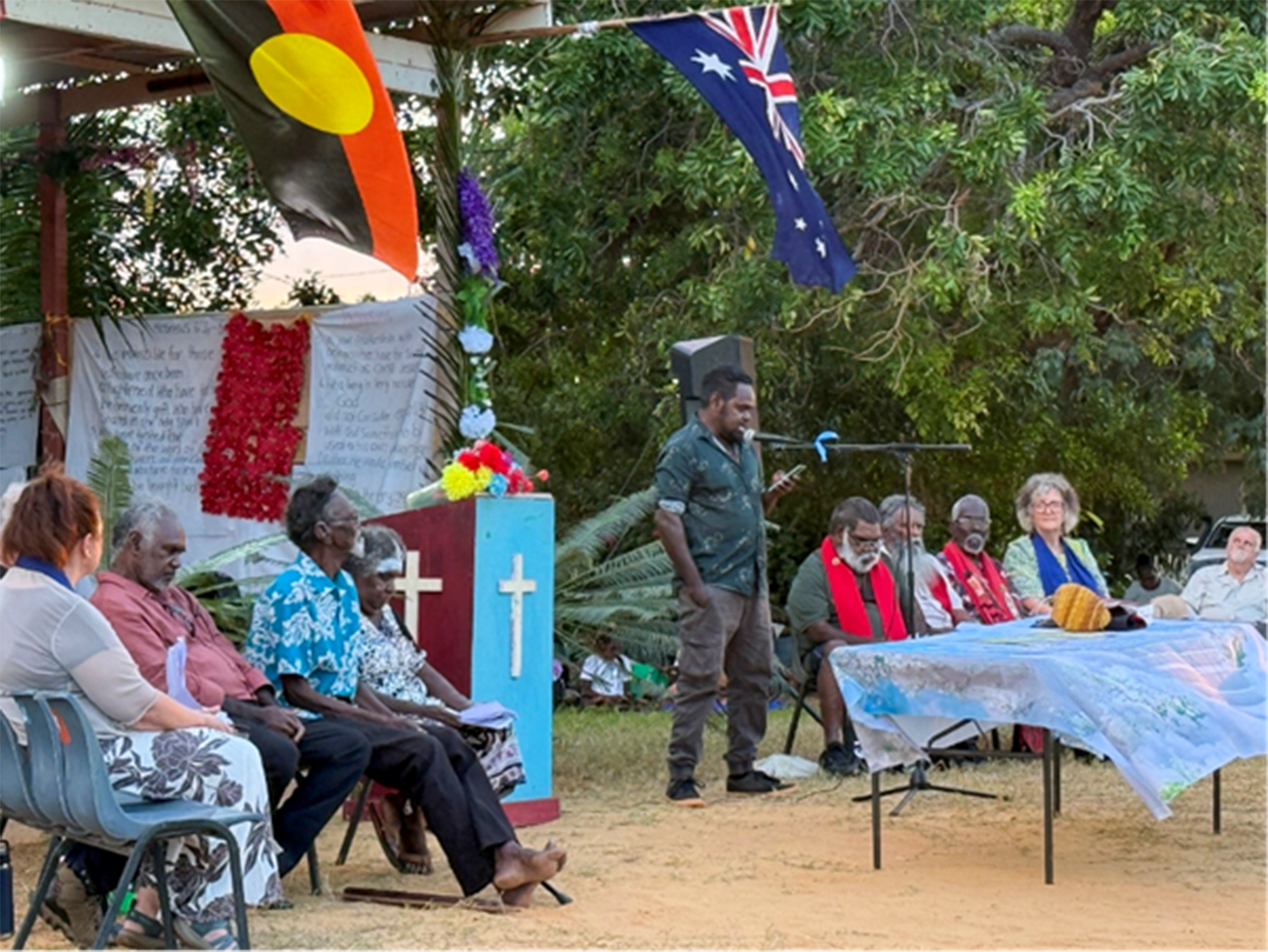
I write this reflection on Pentecost Sunday, as a visitor to Galiwin’ku lands of Elcho Island. I give thanks for the gifts of the Holy Spirit so graciously poured into, received by, and fruitfully grown by the many Aboriginal and Torres Strait Islander communities of people; some I call friends, and some I know as family. And, I acknowledge the God inspired friendships of mutual discernment and discipleship our old people have enjoyed and still enjoy today.
No matter where I go in community, I hear a common lament from our old people. They are all crying out in prayer for our young people to know Christ alongside their culture. Their hope and direction are for young peoples to live in the presence of the Holy Spirit, within a community of disciples and disciple makers. All of them recognise that the body of Christ and the plans God has for us, are a mystery which is bigger than we can fully know. And, that God’s plan includes all peoples, Yolngu and Balanda, Black and White, Urunu and Withu, First and Second Peoples.
So, may this be a word of encouragement for us all, and especially for all of the young people of our churches: you are not forgotten, and you are not standing at the edges of God’s story. You are already part of the living body of Christ, gifted by the Spirit, held by the Creator, and called into the work of forming yourselves under wise and gentle counsel. Your curiosity matters. Your culture matters. Your faith matters. The triune God who has walked with our old people is also walking with you, leading you with courage, wisdom, and hope. Do not be afraid to follow Jesus with your whole life, and in relationship with others. Do not be afraid to bring the strength of who you are into the life of the church, because we together are God’s church and through grace, we will see disciples, leaders, and witnesses raised amongst you.


Discipleship
Discipleship & Mission
Children, Youth, Young Adults and Families
Journey
Latest stories
Browse the latest stories of the Church